Textile ETP Program
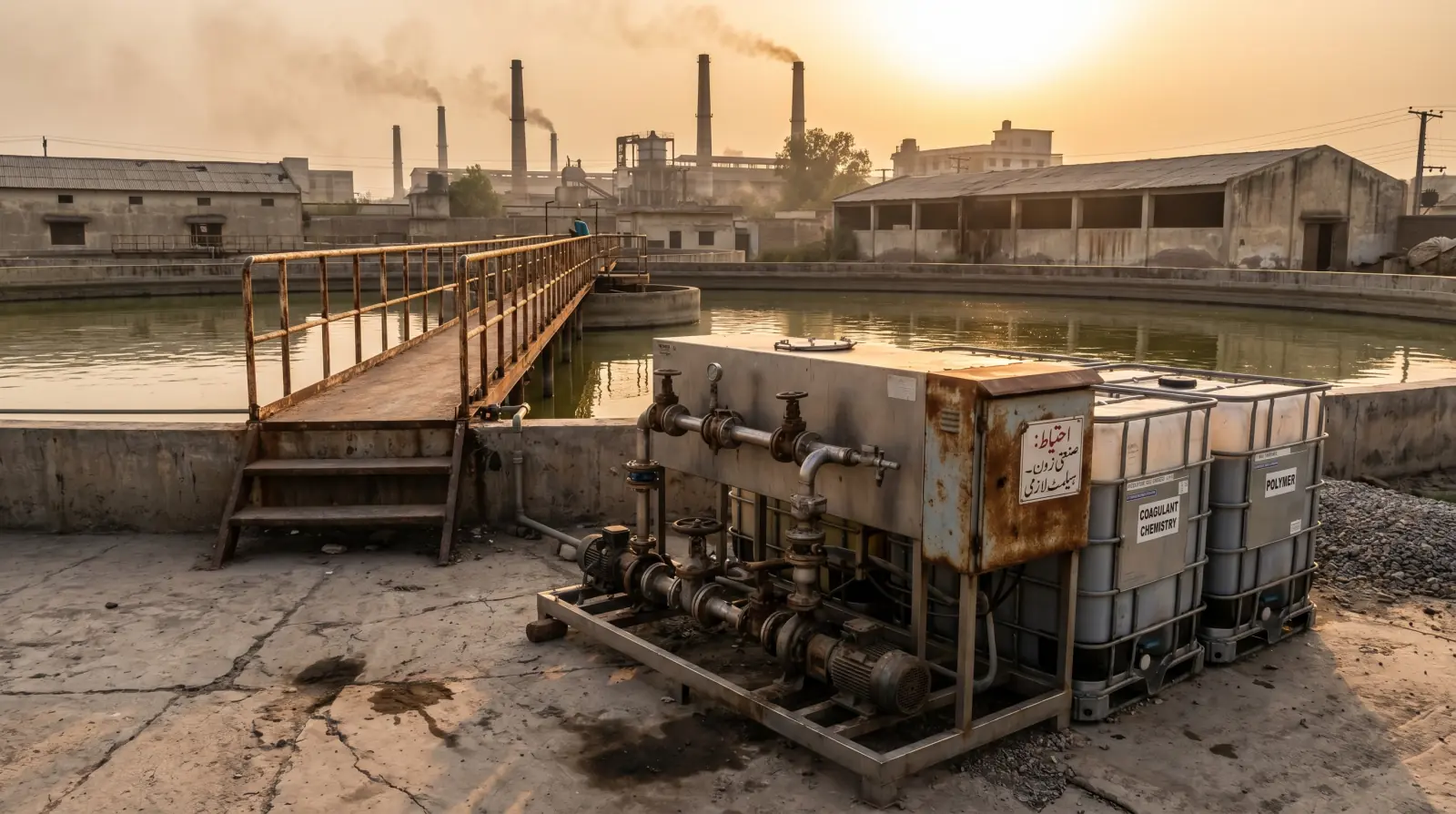
Effluent treatment chemistry for Pakistani textile mills — coagulation, flocculation, biocide, COD reduction, and sludge dewatering on one accountable program.
The accountability we write into every program contract.
SLA, lead-time guarantee, technical-support response, chemistry governance, reorder cadence, escalation path. The Charter is what makes a program a program — not just a recurring PO for the same drums.
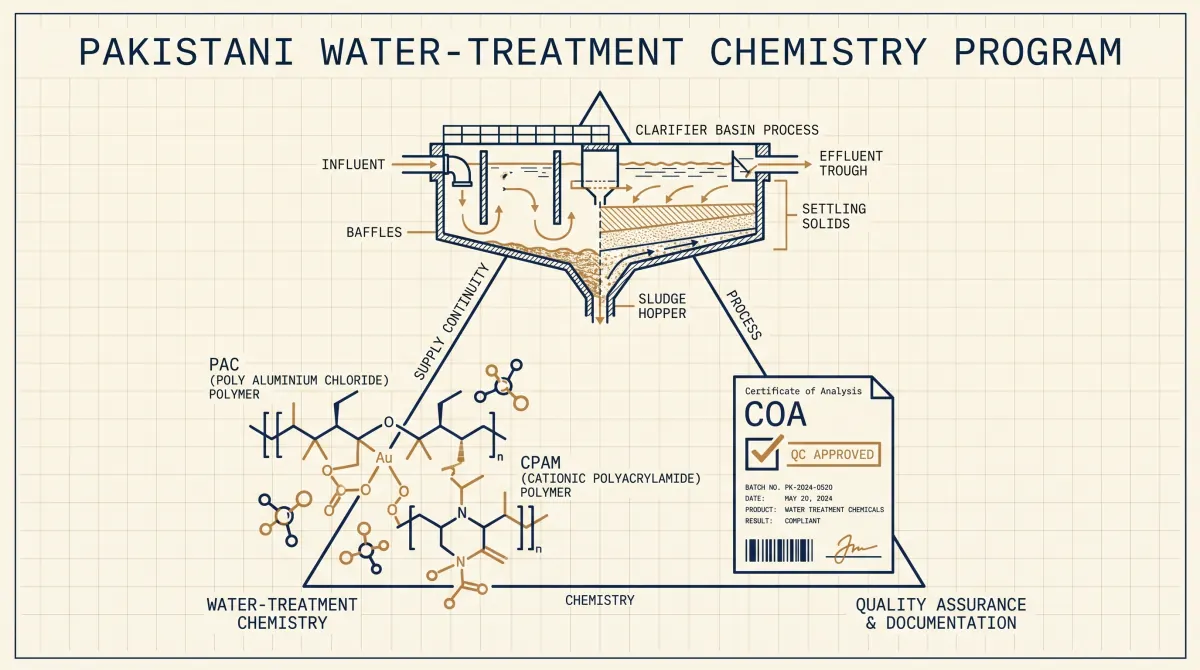
3 chemistries, one supply chain.
Every SKU below is on the AAS-Shaanxi Ande catalogue, stocked in Karachi for the contracted volume window, and reviewed quarterly against the KPI targets below. Click any product for the full TDS and dosing programme.
| SKU | Dosing range | Feed point | Monitoring parameter | Supply frequency |
|---|---|---|---|---|
| PAC Poly Aluminium Chloride |
60–250 ppm (industrial liquid, 10% Al₂O₃) or 30–80 ppm (solid 32% Al₂O₃ dissolved on-site) | Rapid mix tank, before pH correction | Settled-water turbidity (≤ 30 NTU pre-CPAM), residual Al (≤ 0.5 ppm) | Monthly bulk delivery, IBC or 1 MT bags |
| CPAM Cationic Poly Acrylamide |
0.5–4 ppm on liquor (medium-to-high cationic, MW 8–12M) | Slow-mix flocculation tank, after PAC neutralisation | Floc settling rate, sludge dry-solids after dewatering (target 22–28%) | Quarterly delivery, 25 kg bags, dosing-make-up skid commissioned |
| AD-402 Recirculating Cooling Water Non-Oxidizing Fungicide |
30–80 ppm shock weekly; 10–25 ppm continuous if biofilm in equalisation | Equalisation basin or ETP recirculation loop | ATP swab (< 100 RLU), HPC (< 10⁴ CFU/mL), visible biofilm review | Quarterly delivery, drums |
Full effluent characterisation — COD, BOD, TSS, colour (ADMI), salinity, pH, surfactants, residual dye — plus jar testing across PAC grades / CPAM cationicity to specify the exact chemistry sequence for your dye-house mix.
Start-up engineering on coagulation-flocculation skids: rapid-mix energy, slow-mix tip-speed, dosing-pump calibration, sludge-train tuning. 30-day supervised run to steady-state KPIs.
Quarterly site visit — re-jar against current dye-load, recalibrate dose, audit sludge dewatering. Chemistry supply consolidated into the retainer.
Single-vendor stock held in Karachi for ex-stock dispatch. Direct-from-Shaanxi-Ande sourcing on bulk PAC/CPAM with COA per batch.
Real plants on this chemistry.
Anonymised but real. Drawn from the AAS project list — the chemistry, the KPIs, the dose ranges, the failure modes corrected. Names available under NDA.
Continuous chemistry supply on the program SKUs, quarterly KPI audit, dosing calibration. Best fit for facilities already operating with stable chemistry needing accountability.
One-time design and commissioning capex, followed by a 24-month operating retainer at Tier 1 rates. Best fit for new installations, plant retrofits, or chemistry-program rebuilds.
Hourly engineering on troubleshoot, plus access to program SKU supply on per-shipment pricing. Best fit for plants under another vendor’s chemistry needing second-opinion or emergency response.
Pricing bands aren’t published — each program is sized to plant flow rate, SKU mix, metallurgy, and feedwater profile. Submit a Program Proposal request; Rayhan replies with a Charter draft (SLA, KPI targets, BoM, indicative pricing band) within 3 business days.
1. Vendor consolidation.
SKU purchasing fragments the supply chain across three or four vendors per duty — one for each chemistry class, plus the dosing-skid contractor. Each shrugs when the others’ work doesn’t hold. A program collapses that to one accountable vendor with one phone number, one invoice, one engineer on the line.
2. Supply continuity SLA.
Spot purchasing exposes the plant to lead-time risk on every reorder. The program holds buffer stock in Karachi for the contracted SKU range, runs scheduled bulk replenishment from Shaanxi Ande, and commits to a delivery cadence in writing. Predictability is the deliverable, not just chemistry.
3. Chemistry KPI accountability.
SKU sales land at the dose tank. The program lands at the KPI: COD reduction, cycles, corrosion rate, RO flux decline, sludge dry-solids. The Charter writes the KPI target into the contract; we review it quarterly; if the chemistry isn’t holding we tune the dose or escalate to Shaanxi Ande — the procurement officer doesn’t have to chase three vendors to find out whose chemistry slipped.
Every program SKU is sourced through AAS’s sole-agent relationship with Shaanxi Ande Technology Industry (China) and Innovative Water Technology & Solution (Pakistan). That’s a single legal entity at both ends: Karachi office, dosing skid, WhatsApp engineering line, and Shaanxi factory books — no trader in the middle, no second hand-off.
Operationally that means: COA per batch on factory letterhead, lot-traceable; MSDS pre-shipment so the plant HSE team clears documentation before the drums land; 4–8 week lead times on factory-direct bulk replenishment (21–35 days CIF Karachi on standard SKUs); and PKR invoicing available on multi-year contracts to offload FX exposure.
Before you sign with anyone — score them.
10 questions every buyer should ask a chemistry supplier. ISO, COA, MSDS, backup, lead-time, RM origin, sample, payment, support, audit. Interactive scorecard with a printable PDF.
Send us your facility profile.
Three minutes of intake → a Program Charter draft sent within 3 business days. The draft includes SLA, KPI targets, indicative BoM, and a pricing band. From there we converge on the final program over one or two calls.