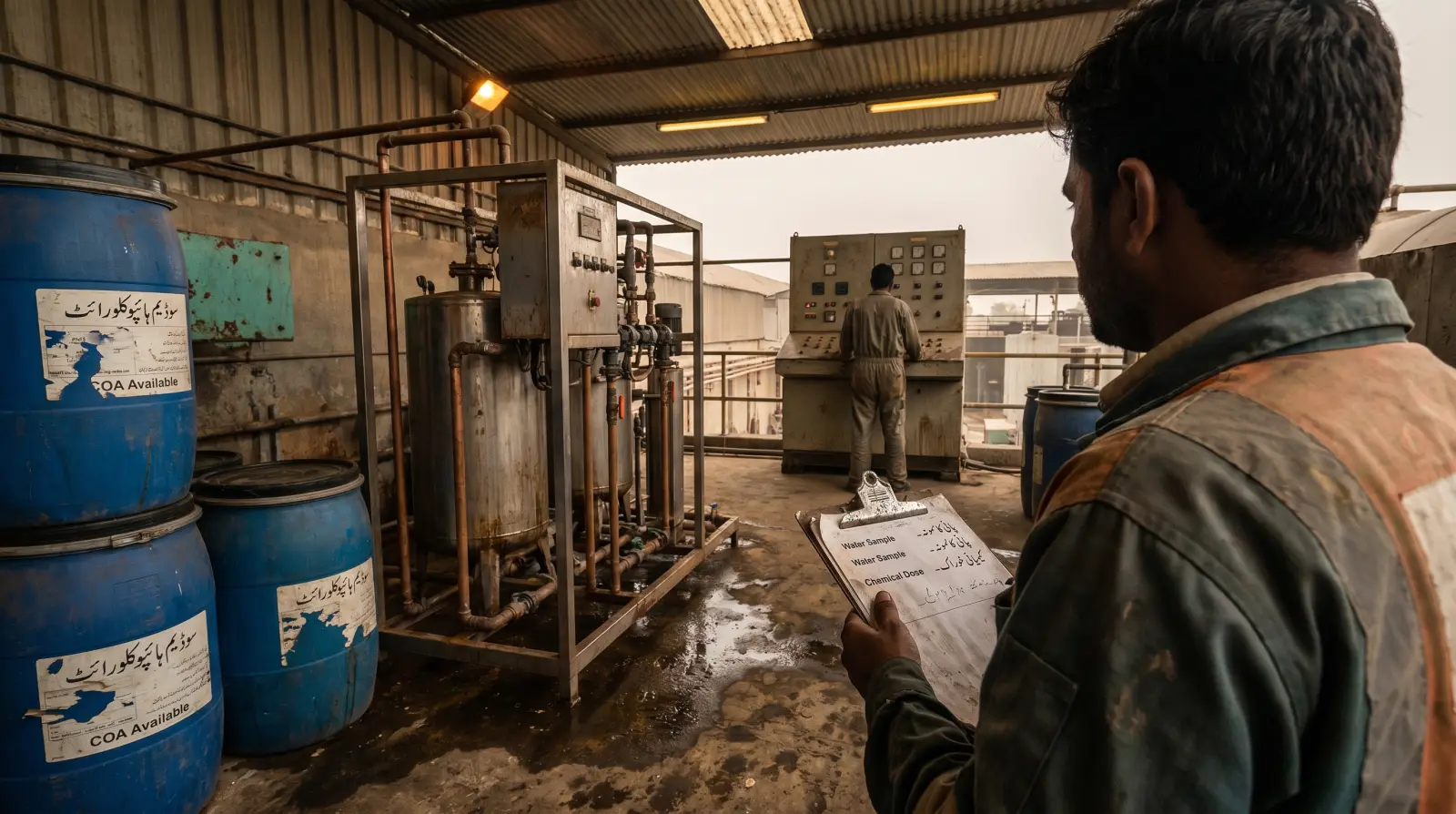
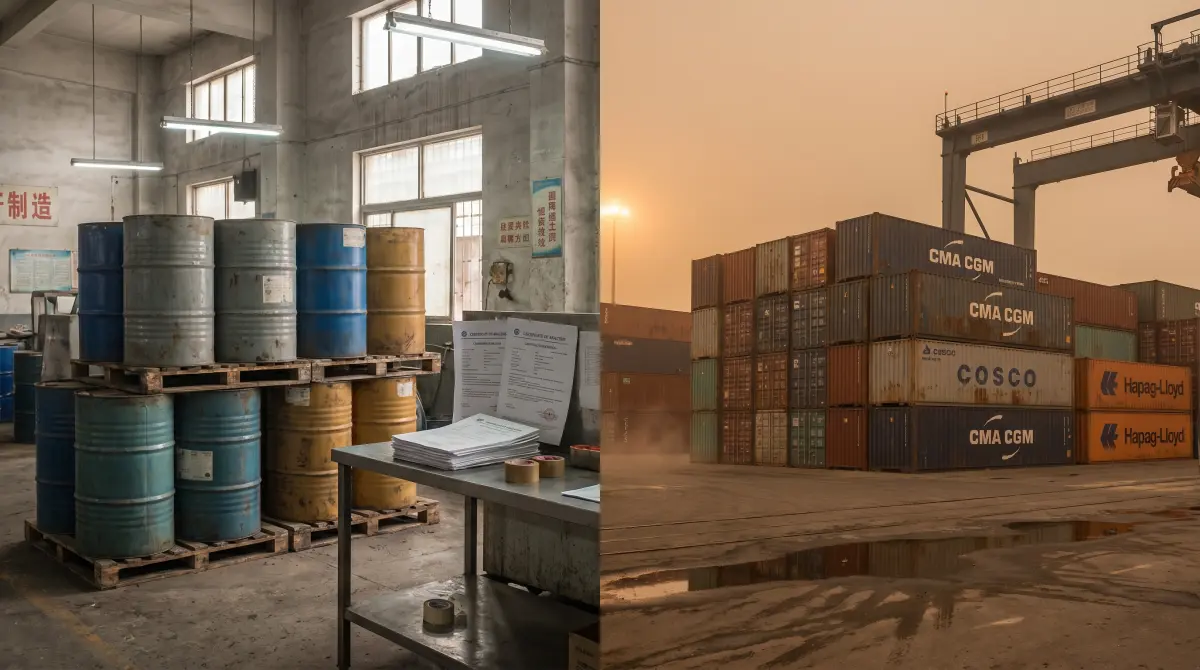
Why it matters: Quality certs (ISO 9001), environmental certs (ISO 14001), EU chemical compliance (REACH), and drinking-water safety (NSF/ANSI 60) tell you whether the manufacturer is even allowed to sell into regulated buyers. A supplier that can't produce current certificates on demand will be the one your tender disqualifies.
AAS answer: Principal Shaanxi Ande holds ISO 9001 and ISO 14001 with REACH registrations against PAC and CPAM grades; NSF/ANSI 60 applies on the drinking-water PAC lane. Certificates available on request before sample-shipment, not after PO.
Why it matters: No COA means no traceability. A real COA is on factory letterhead, lot-numbered, lists every parameter from the technical data sheet (TDS), and is dated within days of production. Round-number values exactly at spec, identical values across consignments, or a different lab signing each one are red flags.
AAS answer: Factory-issued COA per drum lot, cross-checked by our technical desk before the shipment leaves Shanghai. Independent third-party retests available against spec on request. Method: how to read a chemistry COA.
Why it matters: If the MSDS arrives only after the container lands, you can't verify hazard class for the carrier, can't pre-clear customs, and your plant's EHS team can't pre-stage handling. Pre-shipment MSDS is table-stakes for any chemistry above 1 MT.
AAS answer: MSDS issued with the proforma — before the PO, not after the bill of lading. Hazard class + CAS + transport class included; routinely shared with the customer's EHS lead during the sample stage.
Why it matters: Single-source supply on a critical chemistry is a continuity risk, not a cost optimisation. A real supplier names the secondary factory, the qualification lead time, and the spec-equivalence test. "We'll figure it out" is a no.
AAS answer: Karachi stock + Pakistan secondary (Innovative Water) for cooling-tower and RO chemistry, sitting alongside the Shaanxi Ande primary. Stock buffer is the immediate continuity layer; alternate factory qualification path is documented for each SKU. See the corridor model.
Why it matters: A lead-time on the quote is a hope; a lead-time in the contract is a commitment. Ask for a written guarantee with explicit force-majeure language (route disruption, raw-material shortage, currency controls) and what the supplier owes you if the window slips.
AAS answer: 4–8 week factory-direct lead time on bulk replenishment; ex-stock dispatch from Karachi on stocked SKUs (PAC liquid, CPAM, UN-307, UN-611, AD-401, AD-303, AD-402). Force-majeure language in the standing supply agreement; route alternatives between Shanghai → Karachi and Shanghai → Port Qasim.
Why it matters: A repacker that won't name its upstream factory is hiding either margin or risk. You should be able to trace the supply chain one or two hops upstream — the polymerisation plant for CPAM, the chloride-cyanurate manufacturer for biocides, the phosphonate base for antiscalants.
AAS answer: We are the sole Pakistan agent for Shaanxi Ande Technology Industry (China) and Innovative Water Technology & Solution (Pakistan). Principal letters on factory letterhead provided. No third-tier repacking layer.
Why it matters: A confident supplier accepts a paid sample of 5–25 kg at full landed cost, tested against TDS in an independent lab, and a re-pull 2–3 weeks later from a different lot to verify consistency. A supplier that pushes you straight to a 20-MT container is selling you their inventory, not their chemistry.
AAS answer: Sample-first is the default route. 1 MT MOQ on most chemistries already in scheduled production at Shaanxi Ande; sub-MT drums available on stocked Karachi SKUs.
Why it matters: 30% advance / 40% on BL copy / 30% on COA + arrival inspection is the standard structure. Pre-paying 100% removes every lever you have if the shipment is off-spec.
AAS answer: Standard 30/40/30 structure on factory-direct CIF orders; ex-stock Karachi drum sales are net-30 on credit terms once the relationship is established. PKR invoicing available on ex-stock to limit FX exposure.
Why it matters: Chemistry without engineering is just inventory. Ask for the support tiers (procurement-only, technical-desk, on-site commissioning), the named owner per tier, and the response SLA. If the answer is "email us," that's the same as no support.
AAS answer: Tier 1 — Karachi technical desk for feedwater interpretation and dosing programme drafting. Tier 2 — on-site commissioning support for IPP cooling, refinery process, textile ETP, RO pre-treatment. Tier 3 — principal engineer escalation to Shaanxi Ande / Innovative Water for spec-edge cases. 24/7 number on the contact page.
Why it matters: A supplier that refuses an on-reasonable-notice visit to the factory or the QC lab is hiding something. This question doesn't mean every buyer audits; it means buyers can.
AAS answer: Pakistan-side QC lab in Karachi (open to walkthroughs on reasonable notice). Shaanxi-side factory visits arranged with the principal — done before for repeat buyers running their own China procurement audits.